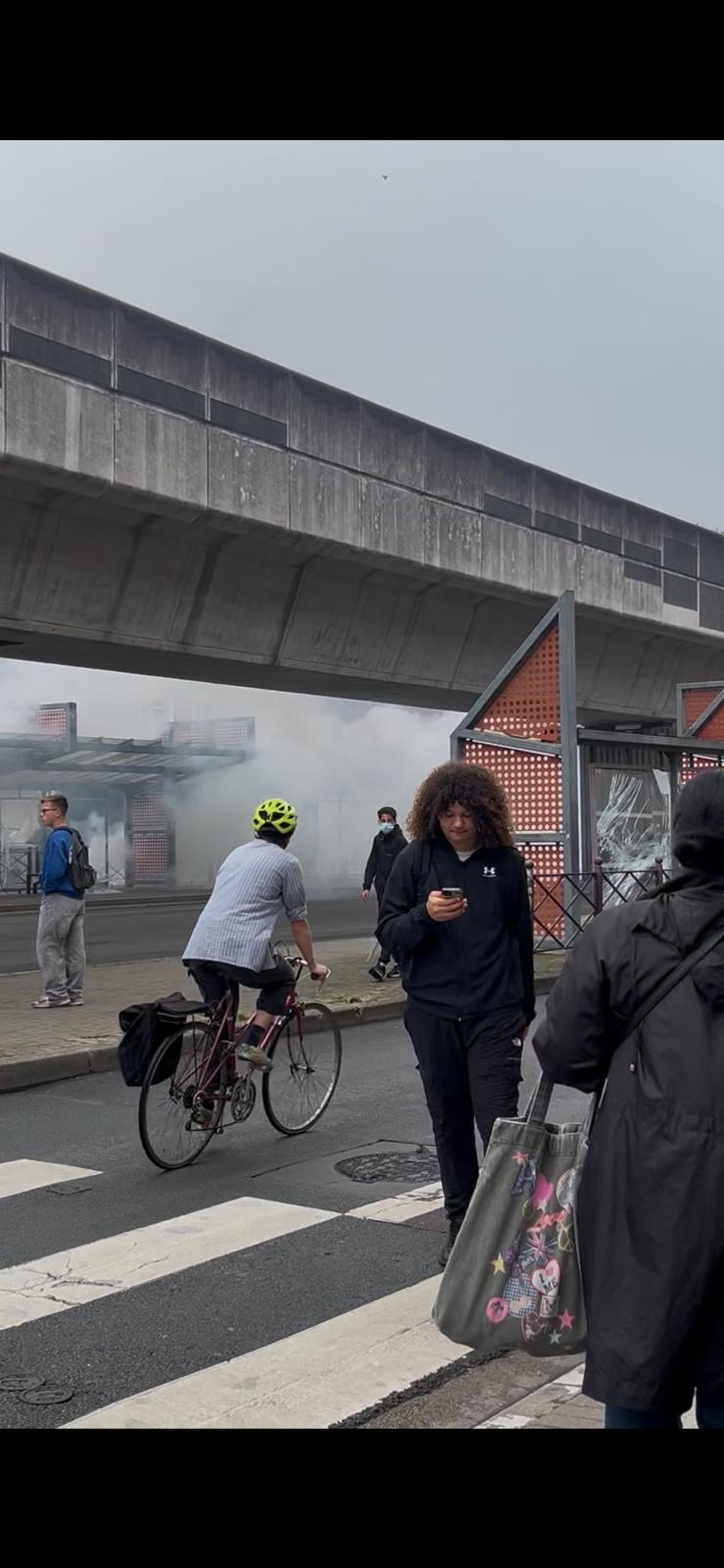
Since the beginning of October, a protest movement has been spreading across France like wildfire, gradually taking in more and more of the issues troubling the French today. The spark was the student movement: pupils at the lycées (state secondary schools) who protested against the conditions they have to put up with at their schools. On top of that, France has announced cuts to the education budget, so there is no real prospect of the situation in schools improving. At the start of these protests, you could only end up at one by mistake, but today, owing to their size, they are all legally announced in advance. But how real are they, and how well can our domestic media distort them?
"Solidarité avec les lycéens" is chanted and written on pieces of cardboard by protesters in large and small towns alike. Perhaps each of them came for a slightly different reason: a voter for Mélenchon (LFI) in the next presidential election, or for parties allied with him; a trade unionist (CGT) dissatisfied with the state of the public services their taxes pay for, or with France's action (or inaction?) over the genocide in Gaza; or secondary-school pupils crammed into classes of up to 40, without air conditioning and in unhygienic conditions.
The first time I took part in a march or demonstration was by mistake, in mid-September. It was a left-wing march through the centre of Lille, and we joined it out of sheer curiosity. The protest was against a law on the legitimacy of the right of defence for law enforcement (les forces de l'ordre, simply police officers in our country), which would allow the use of brute force and weapons if they feel threatened. In other words, they were given permission to kill, which resonated on every homemade piece of cardboard. Representatives of the international organisation Amnesty International also took part in the march, visibly identified and just as mobilised as the rest of the crowd. I did not experience any violence at this protest. However, in Lille all the "marches" end at the Place de la République by the Beaux-Arts. Although this square is spacious, it is also easy to encircle, which is not a characteristic of a square I would ever have noticed before. The police, however, do notice it, and use it for crowd control. When we wanted to leave the by-then relatively empty square after the protest had ended (not that many people had taken part), a fully armed policeman with a shield "jumped" at a friend as a joke. My friend hadn't provoked anyone; he was just walking between them, the way he was going anyway.
Larger protests and mobilisations began on 29 September in the immediate vicinity of lycées in big cities such as Paris, Marseille and Lille. They were mainly human chains, the "aura battles" between police officers and secondary-school pupils that the media made famous, peaceful blockades and chanting. There were press-up contests between a police officer and a pupil, TikTok trends were filmed with police officers, and debates were organised in which teachers also took part. The pupils protested against the state of their schools' buildings and the shortage of teachers. That was when I found out how the police can behave towards demonstrating children. While the police stayed out of it, people sang, played cards and kicked a ball about. But the character of the protest changed the moment police vans full of armoured "enforcers of order" arrived and the protesters began to feel threatened. And when the police first used tear gas near the Porte de Douai metro stop, where there was also a huge number of uninvolved civilians (including me, because it is, after all, a metro stop), only then did the glass on the bus stops begin to be smashed.
What are the police here really like? A lovely illustration of their mindset, stemming from the system, is the very well-known "Bismillah c'est le tenebre", now part of young people's pop culture. The context for this joke, which is now seeping everywhere, is the police's attempt to infiltrate various social-media groups, where they pose as supporters of the demonstrations to find out where the next ones will be held. Given the opening "Bismillah" and the excessive use of Algerian and Palestinian flags in their messages, it is clear that they regard the protesters as mainly the children of Muslim migrants. Far-right groups think along similar lines, regarding these migrants quite literally as weeds in Europe. Police also go "undercover" in the crowds at demonstrations themselves, where they are harder to spot, but they are often tripped up by their own prejudices about protesters and their ignorance of the situation. In one such case, a police officer disguised as a civilian was exposed precisely because, while the other protesters formed a corridor so a fire engine could pass safely, one of the "protesters" pushed his way onto the road and started kicking and hitting the vehicle and shouting abuse. The protesters threw themselves at him to drag him out of the road and, in doing so, managed to tear off the officer's hood and wire.
For a Slovak studying terribly far from home, this is an absolutely different protest culture. We can't even say we are used to it, because protesting back home is nowhere near as frequent. There, we gather in a square for two hours, listen to a few speeches, listen to the anthem and go home, which is diametrically different from what one experiences here. At times I felt more as though I were at a music festival where, instead of a chorus, political slogans are shouted. The contrast in police behaviour and the way they are equipped is also striking. They "direct" protesters in full kit: shield, helmet, weapon, tear-gas grenades, bulletproof vest and covered face. They enjoy their power and know that intimidating protesters, who are wearing nothing but a hoodie and a face mask, is legitimised by the state, and they make use of it. But I went to France knowing about this culture, so it did not surprise me. What did surprise me was the sheer brutality of the police. In our culture this aspect is so different that, since we too are part of Europe, I was convinced that the constant chanting of ACAB (all cops are bastards) was merely an expression of the French dramatic nature and that things weren't as bad as they claimed. Gradually, however, I am discovering that they weren't exaggerating.